The IPO opened at the NGX building in Marina, Lagos on September 14, 2026. It immediately became the first refinery ever to be opened for public subscription in the Nigerian Exchange's 66-year history — marketed explicitly as an IPO "for the people."
According to the prospectus, the refinery has 120.13 billion issued and fully paid ordinary shares, with another 4.1 billion new shares being offered to investors, including the public, at ₦525 per share and a minimum subscription of 10 shares for ₦5,250. The founder, Aliko Dangote, framed the offer as part of a broader push to expand ownership of his companies to ordinary Nigerians.
It is a compelling pitch: a stake in Africa's largest refinery, open to anyone with the means to buy in. But that last clause matters. The question worth asking is not whether the offer is open to the public, but whether it is priced for the public it claims to invite?
The Price Question
₦525 share price lands very differently than it would have a generation ago, when share offers were sometimes advertised at just a kobo or two apiece. That gap reflects, in large part, how far the naira has fallen against the dollar since then, a devaluation that has quietly reshaped what "affordable" means for a retail investor today.
Although there are still shares priced at below 100 naira on the stock market, naira devaluation alone does not explain why Dangote Refinery shares may be priced at ₦525. The amount being raised and the valuation of the company are also significant. Dangote Refinery wants to raise $1.6 billion about ₦2.15 trillion while the company is valued at about $49 billion.
By the time the company is listed, it will be the company with the largest market cap on the stock market. Airtel Africa with market cap of ₦23.68 trillion has a share price of ₦6,300. While Seplat which is in the same oil and gas industry as Dangote Refinery is priced at ₦14,907 per share with a market cap at ₦8.94 trillion.
One interesting question to ask then is what is the capacity of Dangote Refinery to return significant percentage gains to the market with a capitalization of ₦65.22 trillion and a free float of about 3.3%?
With this analysis so far, the Dangote refinery may not look expensive at first glance, but another question emerges when we consider the mechanics of the share price purchase. At ₦525, the shares cannot be bought as it is, but with a minimum purchase order of 10 shares which means the actual amount an individual Nigeria can buy is ₦5,250. Subsequent orders have also to be subscribed for in multiples of 10. This means, an individual can only buy at ₦5,250, ₦52,500, ₦525,000 and so on.
With this arrangement, one wonders how affordable it really might be for a Nigerian to buy a sizable portion of the company or would it mean many might just be locked at the lowest price point of ₦5,250 or ₦52,500 without access to buy more shares from this offer without a higher capital base?
The Case For Optimism
Companies open ownership to the public primarily to raise capital for expansion. The greater the expansion, the greater the potential profit, and the greater the risk investors take on in exchange for dividends.
Dangote's own trajectory offers a precedent. Dangote Cement and Dangote Sugar, both listed on the NGX, are consumer and industrial staples. Few serious competitors, cement rivals like Ibeto and Elephant Cement, struggled to keep pace when Dangote Cement listed. Both Dangote Sugar and Dangote Cement stocks have appreciated over time.
The Case For Caution
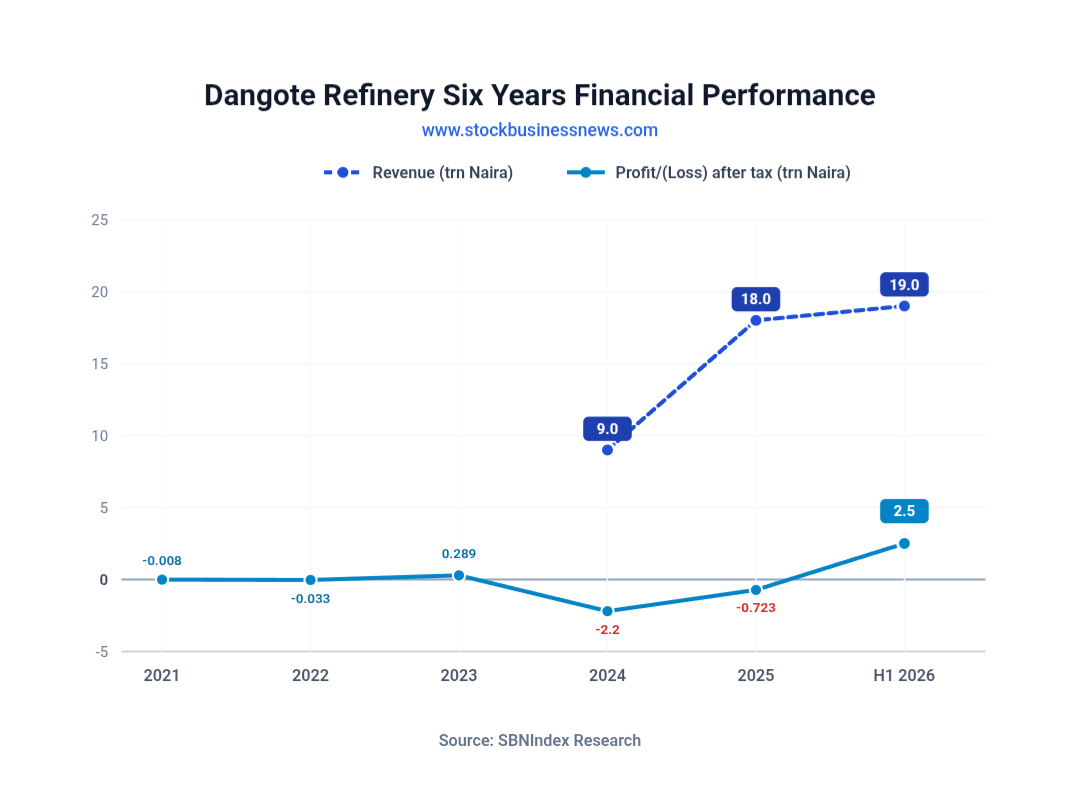
The Refinery's financials tell a more volatile story than the Cement or Sugar's. The company posted a $476 million loss in 2025 before swinging to $1.82 billion in net income in the first half of 2026 — a dramatic reversal that raises the question of whether current profitability can hold.
Unlike Cement and Sugar, which operate in markets with limited competition, the Refinery is exposed to global crude oil prices and feedstock costs that neither of Dangote's other listed companies has to contend with. Analysts have flagged that difficulty securing crude at competitive prices could compress the margins the IPO's valuation depends on.
Share value could also come under pressure if the refinery underperforms, if global oil prices drop while overheads stay fixed, or simply if early investors begin selling — a scenario that doesn't necessarily signal the company is struggling, but can still drag the price down.
What It Comes Down To
The optimistic case and the cautious one are not mutually exclusive: Dangote Refinery could well perform in line with its sister companies if operating conditions hold steady. But retail investors weighing whether to buy in should reckon with a simple reality: the invitation to own a piece of Nigeria's biggest refinery comes at a price that not every Nigerian it claims to include can actually afford.