Nigeria’s stock market has delivered a strong rally in 2026, but the gains have not been evenly distributed across sectors. As of August 21, 2026, the NGX All Share Index had gained 53.81% year to date, while the Consumer Goods Index had risen only 1.62%. In contrast, the Banking, Oil & Gas and Industrial Goods indices had gained 63.18%, 85.76% and 82.84%, respectively.
That gap raises a clear question: why are consumer goods stocks lagging when some of the sector’s biggest companies are reporting a recovery in profitability?
The answer does not appear to be one problem. The sector is recovering, but the recovery is coming mainly from better margins, lower financial pressure and improved cost control rather than a major acceleration in sales.
The latest results from three prominent consumer goods companies, BUA Foods, Nigerian Breweries and Nestlé Nigeria, show how much the sector has changed since the difficult period of 2023 and 2024.
BUA Foods H1 2026 revenue: ₦765.1bn; YOY -16.2%; H1 2026 PAT: ₦292.3bn; YOY: 12.4%
Nigerian Breweries H1 2026 revenue: ₦803.7bn; YOY: +8.9%; H1 2026 PAT: ₦93.0bn; +5.1%
Nestlé Nigeria H1 2026 revenue: ₦650.8bn; YOY: +12.0%; H1 2026 PAT: ₦64.8bn; YOY: +28.1%
BUA Foods
For BUA Foods, Revenue declined by -16%, but profit increased by 12.4% At Nestlé, profit grew much faster than revenue. Nigerian Breweries, meanwhile, returned to meaningful profitability after recording losses in 2023 and 2024.
That difference is important. The sector’s recovery is increasingly about what companies keep from each naira of sales, and how much they spend on finance and other costs, rather than simply selling much more.
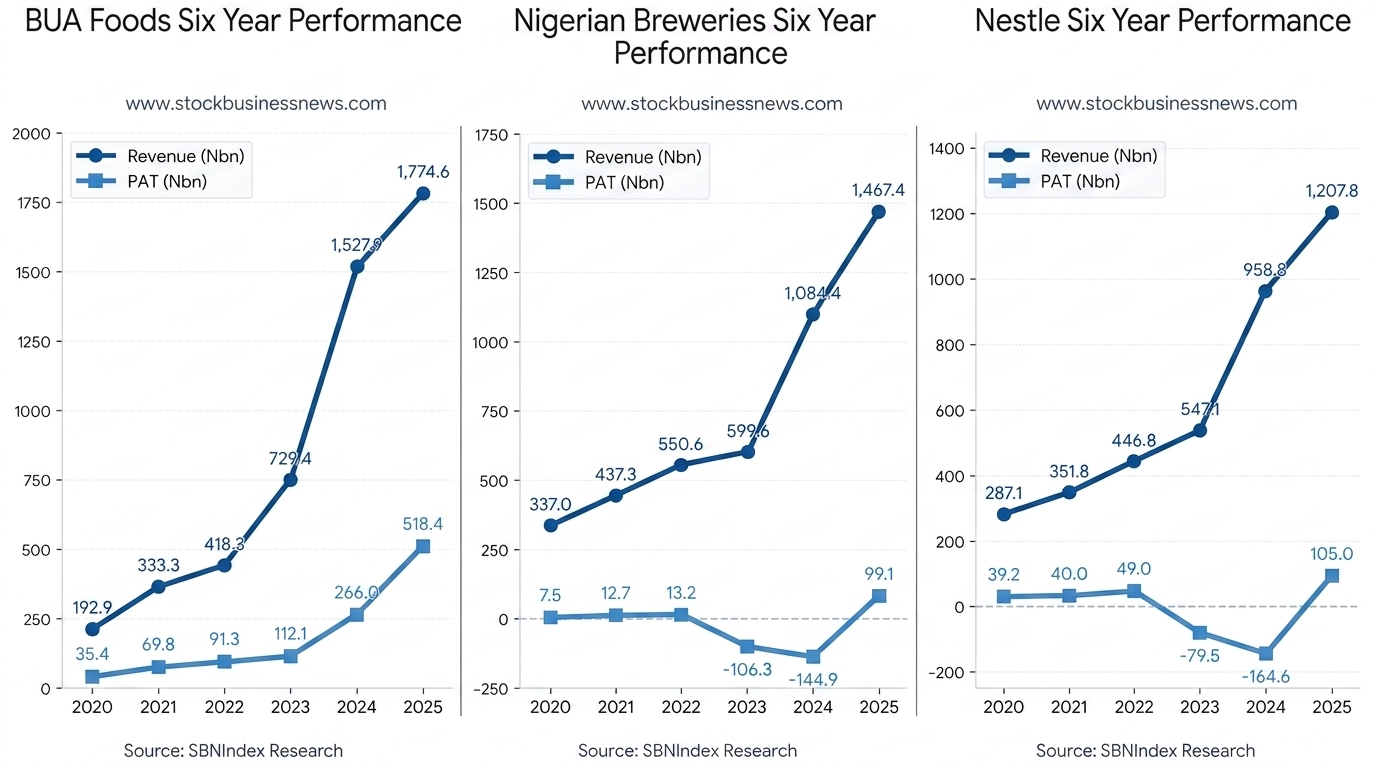
BUA Foods has grown rapidly over the past several years. Revenue rose from about ₦192.9bn in 2020 to ₦1.77tn in 2025, while profit after tax increased from about ₦35.4bn to ₦518.4bn.
The real change is visible in H1 2026. Revenue declined, but profit after tax increased 12.4% to ₦292bn. The company attributed the improvement partly to lower raw material costs and exchange rate stability.
In other words, BUA Foods did not need higher revenue to produce higher earnings in the first half. Better margins did much of the work.
Nigerian Breweries
Nigerian Breweries tells a different story, but it leads to the same conclusion. The most striking period was 2023 and 2024. Revenue rose from roughly ₦600bn to more than ₦1tn, yet the company recorded large losses. The problem was not simply weak demand for beer. Foreign exchange losses and finance related pressures overwhelmed operating earnings.
By H1 2026, the picture had changed. Revenue reached ₦803.7bn, operating profit was about ₦164bn, profit before tax was ₦156.3bn and profit after tax was ₦93bn. The turnaround shows how much the company’s earnings can change when the financial burden becomes more manageable.
Nestlé Nigeria
Nestlé Nigeria’s numbers tell perhaps the clearest story of how inflation and currency pressure can distort the relationship between sales and profit. Nestlé’s revenue more than quadrupled between 2019 and 2025, but the company moved from profit into substantial losses during the FX crisis before returning to profit in 2025.
H1 2026 continued that recovery. Revenue rose 12% to ₦650.8bn, operating profit increased to about ₦141.4bn, profit before tax rose to roughly ₦126.8bn and profit after tax increased 28.1% to ₦64.8bn.
Broader Sector Outlook
The three companies are not isolated cases. An analysis of ten major listed consumer goods companies found the same story. The ten major listed companies are: Nigerian Breweries Plc; BUA Foods Plc; Nestle Nigeria Plc; Dangote Sugar Refinery Plc; International Breweries Plc; Guinness Nigeria Plc; Unilever Nigeria Plc; Cadbury Nigeria Plc; NASCON Allied Industries Plc and Champion Breweries Plc. The analysis found that their combined H1 2026 revenue was about ₦3.53tn, compared with ₦3.51tn a year earlier. That is effectively less than 1% growth.
That may be the most important number in the story. Sales barely moved, but profit increased sharply. The sector is therefore seeing a recovery in earnings that is being driven to a large extent by margins and lower financial pressure.
It is necessary to look back at the FX shock. Between 2023 and 2024, consumer goods companies faced rapid naira depreciation, higher imported input costs, expensive financing, foreign exchange losses, rising energy and logistics costs, and weaker consumer purchasing power.
That produced an unusual situation. Companies could report much higher nominal revenue because prices were rising, while their bottom lines deteriorated.
Nestlé is a clear example. Revenue rose from ₦446.8bn in 2022 to ₦547.1bn in 2023 and then ₦958.8bn in 2024. Yet profit after tax moved from ₦49bn to a loss of ₦79.5bn and then a loss of ₦164.6bn.
Nigerian Breweries went through a similar period. The lesson is simple: revenue growth during an inflationary period does not automatically mean that the underlying business is becoming healthier.
Then came 2025. The Consumer Goods Index gained about 129.6%, far ahead of the All Share Index, which gained about 51%.
That matters when looking at the sector’s 1.62% return in 2026. Investors may not have ignored the consumer goods recovery. They may have priced much of it in earlier.
If investors bought consumer stocks in 2025 because they expected currency stability, lower finance costs, stronger margins and better earnings, much of that expectation may already have been reflected in share prices by the start of 2026.
Strong earnings growth does not automatically mean a stock will repeat the performance of the previous year.
But the money already go somewhere else. Other sectors of the NGX market has delivered robust ytd performance.
YTD Index return as of Aug. 21, 2026
Oil & Gas: +85.76%
Industrial Goods: +82.84%
Banking: +63.18%
NGX All Share Index: +53.81%
Banking has benefited from the recapitalization story and strong earnings expectations. Oil and gas stocks have had their own earnings and commodity drivers, while industrial stocks have also delivered large gains.
The evidence does not support a one-sided conclusion that Nigerian consumer goods companies are struggling. It points to something more nuanced. Nigeria’s consumer goods companies are recovering financially, but the stock market is asking for more than a return to profitability. After the sector’s huge rally in 2025, investors appear to be looking for proof that stronger margins, lower finance costs and better earnings can be sustained.