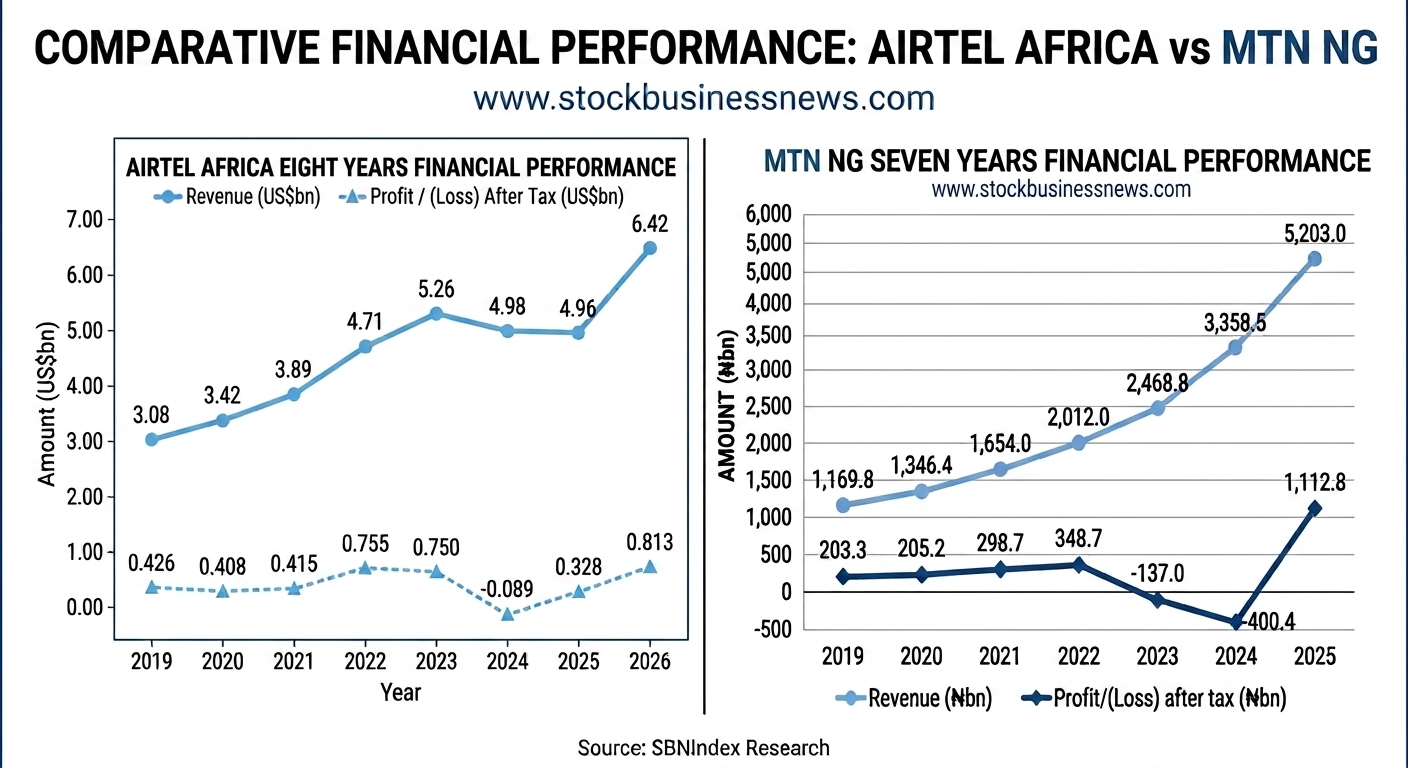
Nigeria’s telecommunications industry has entered a markedly different financial period since the Nigerian Communications Commission (NCC) approved tariff adjustments of up to 50% in January 2025. The decision followed years of rising operating costs, high inflation and naira depreciation. Operators had sought increases of more than 100%, but the regulator capped the adjustment at 50%.
More than a year later, the results of the country’s two major listed telecom stocks MTN Nigeria Communications Plc and Airtel Africa Plc show that the tariff increase has had a significant effect on revenue and profitability. The story, however, is larger than a simple equation of higher prices equalling higher profits. Stronger data consumption, improved foreign-exchange conditions and tighter cost management have all played important roles.
MTN Nigeria: From ₦400 Billion Loss to ₦1.1 Trillion Profit
MTN Nigeria offers the clearest illustration of the turnaround. Revenue rose steadily from about ₦1.17 trillion in 2019 to ₦1.35 trillion in 2020, ₦1.65 trillion in 2021, ₦2.01 trillion in 2022 and ₦2.47 trillion in 2023. Bottom line performance then deteriorated sharply. The company reported a ₦137 billion loss after tax in 2023, followed by a ₦400.4 billion loss in 2024. The 2024 result was dominated by a ₦925.4 billion foreign-exchange loss linked to the naira’s depreciation.
In 2025 the picture reversed. Revenue jumped 54.9% to ₦5.20 trillion, while profit after tax swung from a ₦400.4 billion loss to a ₦1.11 trillion profit. Data revenue rose 74.5% to ₦2.78 trillion and became the company’s largest revenue stream.
The recovery has continued into 2026. For the six months ended June 2026, MTN Nigeria reported revenue of ₦2.99 trillion, up 25.9% year-on-year. Profit after tax increased 70.6% to ₦707.5 billion, while profit before tax reached ₦1.09 trillion. Data revenue alone climbed 38.4% to ₦1.70 trillion. The sustained improvement indicates that the recovery is not confined to a single financial year.
Airtel Africa Shows a Parallel Recovery
Airtel Africa’s figures cover the group’s entire African operations rather than Nigeria alone, and its financial year ends in March (unlike MTN Nigeria’s December year-end). The numbers still tell a similar story: The 2024 result reflected the impact of currency devaluations, particularly in Nigeria, turning a $750 million profit the previous year into an $89 million loss. By the year ended March 2025 the group had returned to a $328 million profit. In the year ended March 2026, profit after tax more than doubled to $813 million while revenue rose 29.5% to $6.42 billion.
Nigeria was a major contributor. Airtel Nigeria’s revenue increased from $1.045 billion in FY2025 to $1.598 billion in FY2026 — growth of 52.8% in reported currency and 47.4% in constant currency. Underlying EBITDA jumped 76.8% to $924 million. Management attributed the performance to customer growth, higher average revenue per user and strong data demand, with the tariff adjustments providing additional support.
Data Growth Matters More Than the Tariff Increase Alone
Customers did not simply abandon the networks after prices rose. Data usage continued to expand. Airtel Nigeria’s data revenue increased 69.8% in reported currency in FY2026 to $820 million. Data customers reached 31.4 million and usage per customer rose significantly. MTN Nigeria recorded a 74.5% rise in data revenue to ₦2.78 trillion in 2025, followed by a further 38.4% increase to ₦1.70 trillion in the first half of 2026.
These trends indicate that Nigeria’s telecom market is becoming increasingly data-led. Mobile phones are no longer used primarily for voice calls and SMS. They are the main channel for social media, streaming, banking, online business, education, remote work, entertainment and digital payments. Higher tariffs raised the price of connectivity, yet underlying demand for data remained robust.
Stock-Market Reaction
The financial recovery has been visible in the share prices of both companies on the Nigerian Exchange (NGX). MTN Nigeria ended 2024 at ₦200. By February 2026 the stock was trading around ₦760 after a gain of approximately 155.5% in 2025. It later moved above ₦900 before pulling back; on 11 August 2026 it closed at ₦805 after a 4.73% decline amid broader market profit-taking.
Airtel Africa’s Nigerian-listed shares started 2026 at around ₦2,270. By 11 August they had reached ₦6,300 after an 8.59% single-session gain, lifting the company’s NGX market capitalisation to approximately ₦23.7 trillion — a rise of roughly 177.5% from the start of the year. The move also helped push total NGX market capitalisation above the ₦160 trillion mark for the first time.
Risks Remain
The strong numbers do not mean the operating environment is now risk-free. Both companies remain exposed to inflation, exchange rate volatility, energy costs and the purchasing power of Nigerian consumers. MTN’s 2024 experience remains a cautionary example: solid operating performance was overwhelmed by foreign-exchange losses. Airtel Africa faced a similar currency driven setback in the same period.
There is also a practical limit to how far prices can rise before customers begin to ration usage. The next phase of growth is therefore less likely to depend on further large tariff increases. Instead, it will hinge on whether operators can sustain revenue expansion through higher data consumption, subscriber growth, digital services and mobile financial services while continuing to control costs.
What the Numbers Show
Nigeria’s telecom sector has moved from a period of severe financial pressure into one of strong earnings recovery. MTN Nigeria’s swing from a ₦400.4 billion loss in 2024 to a ₦1.11 trillion profit in 2025, followed by ₦707.5 billion profit in the first half of 2026 alone, is particularly striking. Airtel Africa’s move from an $89 million loss in FY2024 to an $813 million profit in FY2026 is equally notable, with Nigeria playing a central role.
The tariff adjustment helped close the gap between service prices and the rising cost of running networks. Yet the deeper signal is that Nigerians continue to consume more connectivity even as it becomes more expensive. Data growth, rather than the tariff increase itself, is therefore one of the most important indicators to watch.
For investors, the key question is no longer simply whether MTN and Airtel can raise prices again. It is whether they can keep growing revenue and profit without relying on another major tariff hike. The answer will determine whether the current telecom rally on the NGX marks the start of a longer term earnings story or merely another strong phase in the equity’s market.